


Executive Summary
The global SaaS market is projected to reach $307 billion in spending by 2026, up from $158.2 billion in 2020, an 11.7% CAGR during 2020-2026 [1]. Yet, 9 out of 10 startups fail due to premature scaling and weak product foundations [2]. For SaaS founders, this means an MVP cannot be a throwaway experiment. It must validate market fit while establishing a foundation that scales.
This article explores best practices for SaaS MVP development in 2025, covering architecture, stack choices, monetization models, security features, and industry-specific considerations. The goal is to help startups build a minimum viable product that attracts investors, scales with demand, and avoids costly re-engineering.
I. Why Scalability Matters from Day One
An MVP validates demand, but if built without scalability in mind, it creates technical debt that eventually stalls growth. Technical debt is essentially the “tax” companies pay to fix existing technology issues, and research shows it accounts for about 40% of IT budgets. On top of that, organizations spend an additional 10-20% of every project’s cost just to manage this debt [3].
Investors in 2025 expect MVPs to demonstrate not just market potential but also architecture quality. A SaaS MVP that cannot scale across users, geographies, or compliance requirements is often deemed uninvestable.
The difference between a “prototype MVP” and a “scalable MVP” is the difference between short-lived validation and long-term traction.
II. Defining Your MVP Development Approach
MVP development focuses on creating the leanest version of a product that delivers measurable value. Its objectives:
- Validate product-market fit with real users
- Minimize time-to-market
- Build investor confidence with a functioning platform
Development Timeline
- Ideation and scoping: 2-3 weeks
- Design and prototyping: 4-6 weeks
- Development and integration: 3-6 months, depending on complexity
- Launch and iteration: Continuous
Today, iterative MVP cycles are standard. Founders prioritize modularity and customer feedback loops to refine features without bloating budgets.
III. Core Architectural Foundations for an MVP
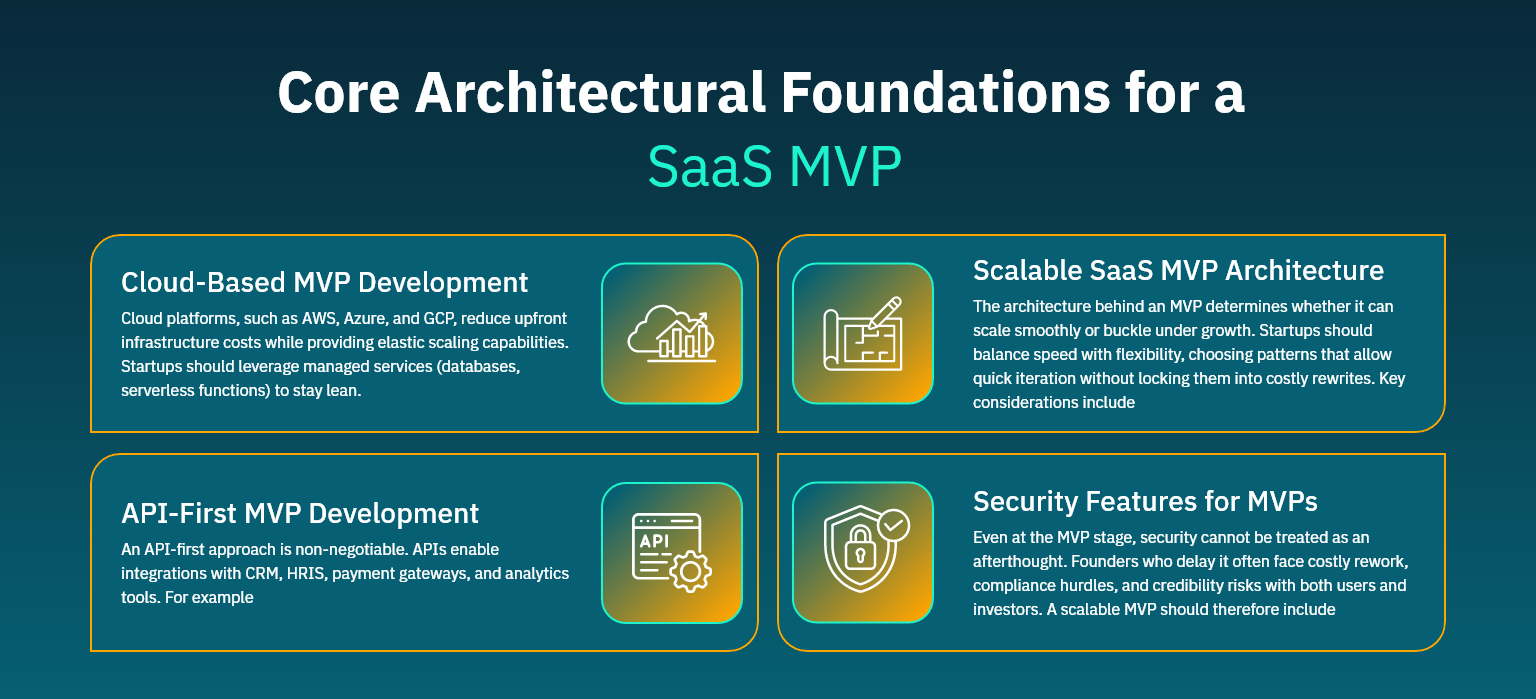
The foundation you choose, how the product is architected, secured, and integrated, determines whether the MVP can evolve with customer demand or collapse under scale. A strong architecture sets the tone for flexibility, resilience, and long-term cost efficiency.
Cloud-Based MVP Development
Cloud platforms, such as AWS, Azure, and GCP, reduce upfront infrastructure costs while providing elastic scaling capabilities. Startups should leverage managed services (databases, serverless functions) to stay lean.
Scalable SaaS MVP Architecture
The architecture behind an MVP determines whether it can scale smoothly or buckle under growth. Startups should balance speed with flexibility, choosing patterns that allow quick iteration without locking them into costly rewrites
Key considerations include:
- Microservices vs. Monolith: While monoliths accelerate early builds, modular microservices ensure flexibility and easier scaling.
- Serverless Functions: Ideal for unpredictable workloads.
- CI/CD Pipelines: Enable rapid iteration and safe rollouts.
API-First MVP Development
An API-first approach is non-negotiable. APIs enable integrations with CRM, HRIS, payment gateways, and analytics tools. For example:
- An HR MVP must integrate with payroll APIs to facilitate seamless payroll processing.
- A fintech MVP needs KYC and AML APIs to enable secure onboarding and compliance with regulatory standards.
Security Features for MVPs
Even at the MVP stage, security cannot be treated as an afterthought. Founders who delay it often face costly rework, compliance hurdles, and credibility risks with both users and investors. A scalable MVP should therefore include:
- Role-based access control
- Data encryption (at rest and in transit)
- Multi-tenancy safeguards
- Compliance readiness (HIPAA for healthcare, PCI-DSS for fintech)
IV. Choosing the Right SaaS MVP Tech Stack
A SaaS MVP is only as strong as the technology it’s built on. The stack defines not just performance but also the speed of development, hiring feasibility, and long-term scalability. Startups must weigh quick wins against future needs, selecting tools that allow them to validate fast without boxing themselves into rigid systems later.
Tech Stack Comparison
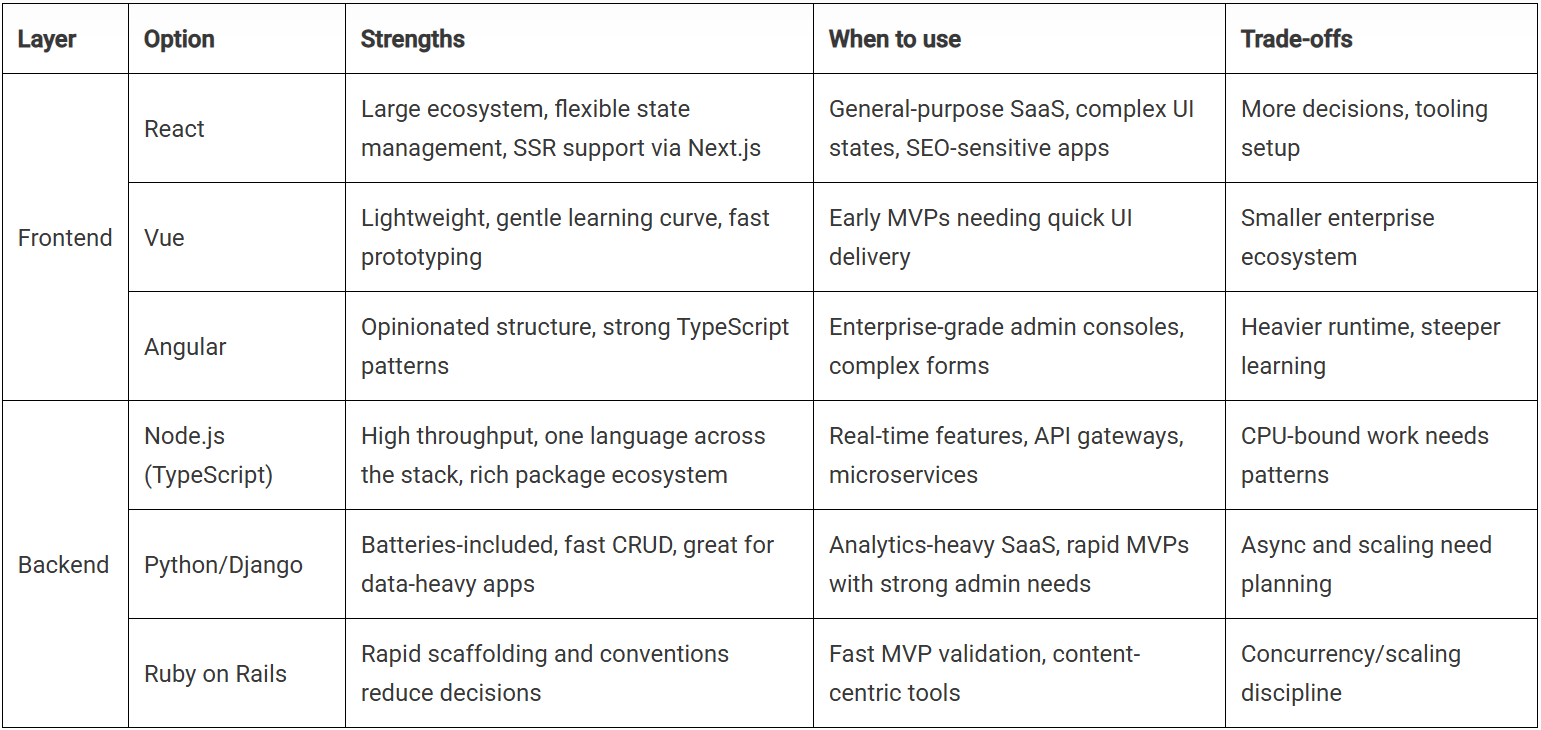
Quick Decision Guide
- Choose Node.js + PostgreSQL if you’re building a general-purpose B2B SaaS with real-time features and expect fast iteration needs.
- Opt for Django + PostgreSQL for analytics-heavy or workflow-centric SaaS products where speed of CRUD development and admin tooling are top priorities.
- Pick serverless + Firestore/DynamoDB when traffic patterns are unpredictable, operations teams are lean, and you want pay-per-use scalability.
- Start with a monolith-first approach using a containerized stack, then break it down into microservices when scaling bottlenecks are identified.
Note: Always get an expert advice from an implementation partner before getting started so as to avoid costly failures or misalignment of tech stacks.
V. MVP Monetization Models and Budget Considerations
Seed investors in 2025 expect more than just a functional MVP. They look for evidence that the product can sustain itself financially. While 35% of startups fail due to a lack of market need, nearly 38% also fail because they run out of capital during the MVP-to-scale transition [4]. A well-thought-out monetization strategy signals to investors that the MVP is not just technically sound but also commercially viable.
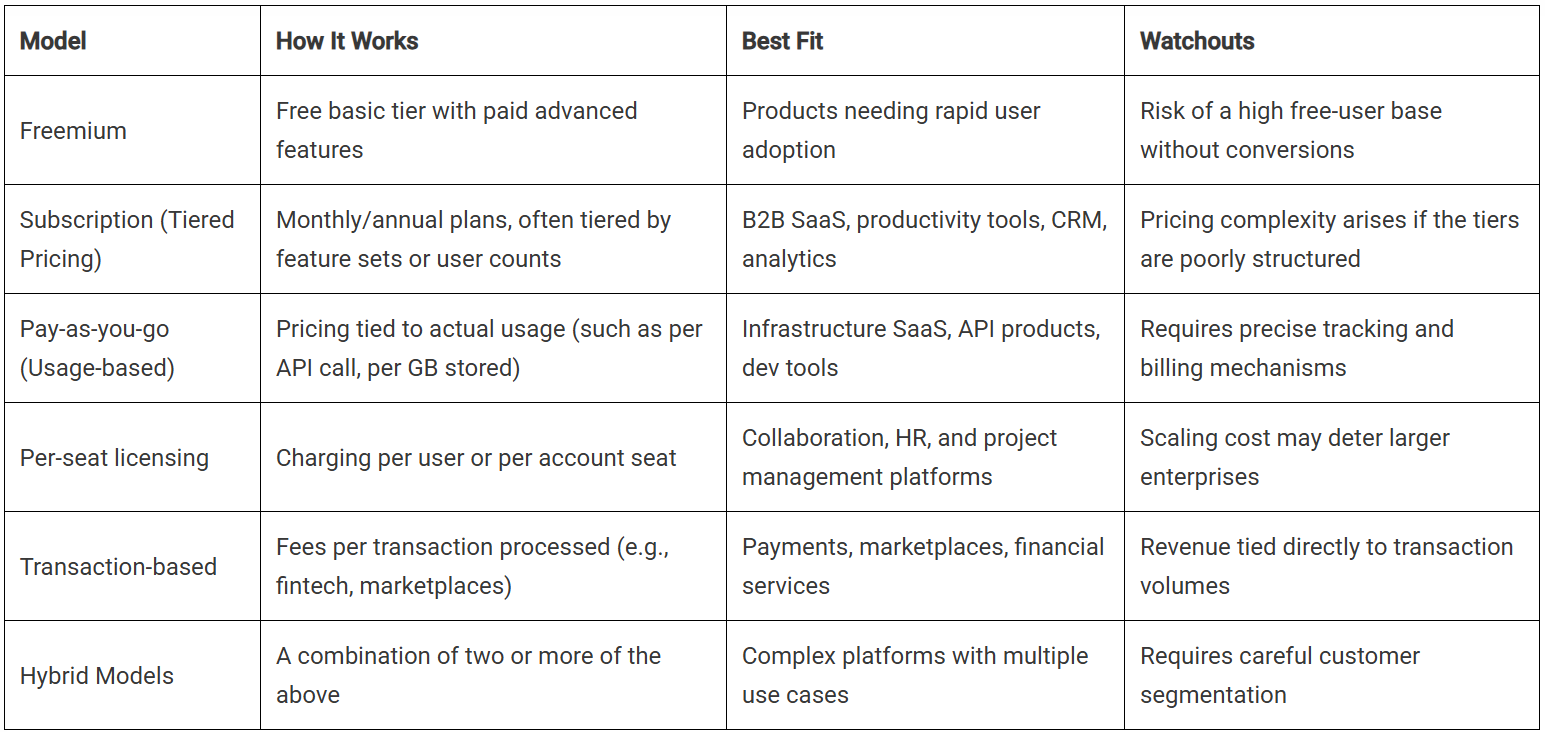
Aligning Monetization with the MVP Stage
- Early MVPs often start with freemium or basic subscription tiers to validate willingness to pay.
- Investor-ready MVPs should demonstrate clear unit economics, such as customer acquisition cost (CAC) vs. lifetime value (LTV).
- Scaling stage products can layer in hybrid models to optimize for both adoption and revenue.
Budget Implications
Choosing the right monetization model also impacts MVP development costs. For example, usage-based billing requires the early integration of metering and analytics, whereas subscription models may need robust billing and invoicing systems from the outset. These are strategic decisions that directly influence scalability and funding requirements.
VI. Industry-Specific MVP Considerations
While all MVPs share common principles, industry-specific requirements can define success or failure. Compliance standards, integrations, and user expectations differ widely across fintech, healthcare, retail, and enterprise solutions. Addressing these from the outset ensures the MVP is not only viable but also credible with investors and early adopters.
Key Considerations by Industry
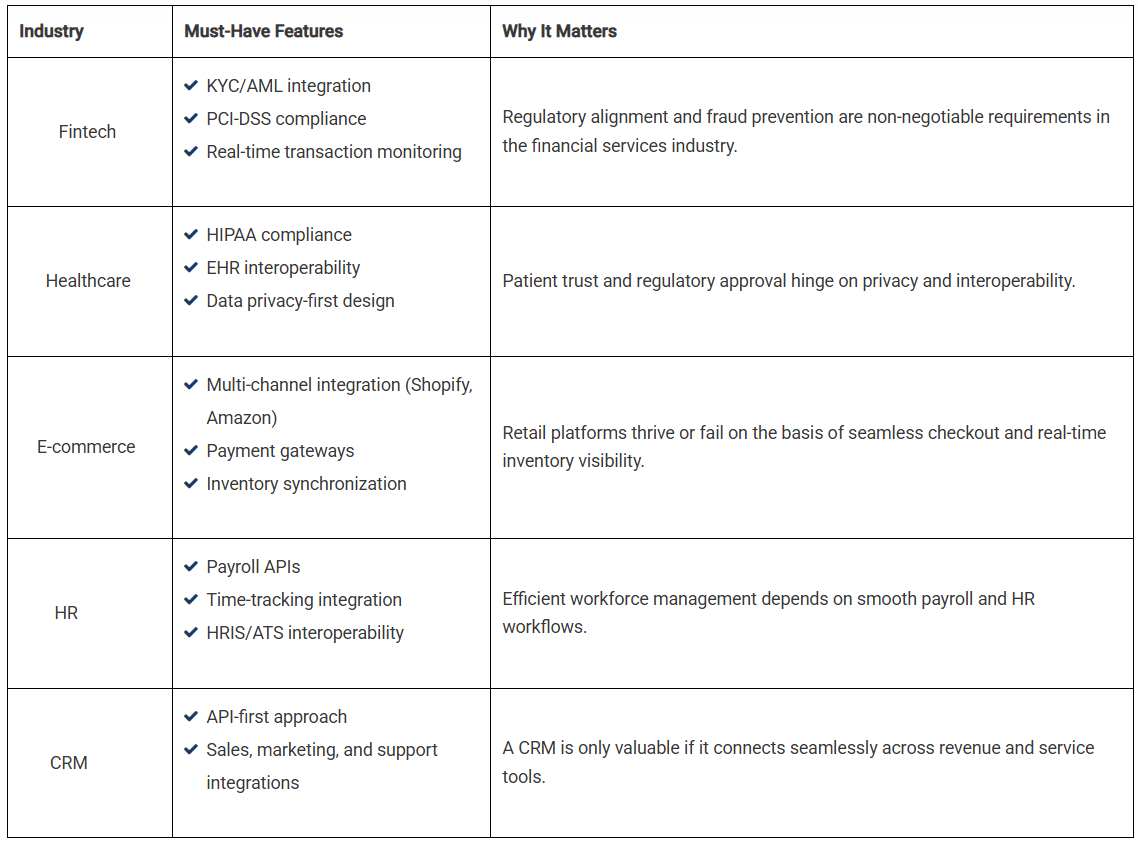
Designing these industry-specific features into the MVP stage avoids costly compliance gaps or integration overhauls later, ensuring scalability is built in from the beginning.
VII. How Matellio Accelerates MVP Success
Building an MVP that balances speed, scalability, and compliance is complex. Many startups struggle to choose the right architecture, avoid technical debt, or meet investor expectations within budget. That’s where Matellio comes in.
As a full-cycle SaaS development partner, Matellio supports enterprises, SMEs, and startups with tailored MVP solutions. From consulting and cloud-native architecture design to API development, modernization, and compliance-readiness, our team delivers MVPs engineered for growth.
Whether it’s a fintech MVP requiring PCI-DSS alignment, a healthcare product built for HIPAA compliance, or a retail platform needing multi-channel integration, we ensure every build is investor-ready and scalable from day one.
VIII. Driving Scalable Growth Through Cloud-Native DevOps
As eCommerce businesses scale, traditional SaaS solutions often become restrictive, both technically and financially. Cloud-native DevOps solutions provide a more agile and cost-efficient path by eliminating vendor lock-in, reducing overhead, and enabling continuous delivery with minimal downtime.
With containerized infrastructure, automated pipelines, and real-time scalability, businesses can optimize performance while maintaining complete control. Cloud-native DevOps isn’t just about lowering costs; it’s about building a future-ready foundation that adapts with your growth.
Matellio specializes in end-to-end cloud integration and DevOps services, seamlessly connecting enterprise applications, data, and systems to drive scalability and innovation. We help businesses modernize operations, accelerate delivery, and build resilient, future-ready platforms.
Key Takeaways
- Scalability First: Designing for scale from day one prevents costly technical debt and rebuilds.
- Structured Approach: A phased MVP process (ideation, design, build, iterate) keeps development lean and investor-ready.
- Architecture Matters: Cloud-native, API-first, and secure foundations set the stage for long-term growth.
- Revenue Strategy: In 2025, investors expect SaaS MVPs to pair scalability with a clear monetization model, such as freemium, subscription, or usage-based, to demonstrate both product-market fit and financial viability.
- Industry Readiness: Compliance and integration needs differ by sector, making early alignment critical.
FAQ’s
1.What’s the typical timeline for SaaS MVP development?
Timelines vary by complexity: 3–6 weeks for basic builds, 6–9 weeks for intermediate MVPs, 9–15 weeks for complex projects, and 16 weeks or more for enterprise-grade products.
2. How to build a SaaS MVP with a limited budget?
Use open-source frameworks, adopt low-code tools for early validation, and prioritize phased rollouts that deliver core value first while deferring advanced features until funding is secured.
3. How long does it take to launch a SaaS MVP?
Most MVPs launch within 6–15 weeks, depending on the scope. Complex or enterprise-grade builds with advanced integrations or compliance features can take longer than 16 weeks.
4. Should I build an SaaS MVP in-house or outsource?
In-house teams offer greater control but require hiring overhead. Outsourcing accelerates timelines and reduces costs, especially for regulated industries. Many startups use a hybrid approach, outsourcing initial builds, then transitioning in-house.
5. How to find a reliable SaaS MVP development company?
Look for providers with SaaS case studies, cross-industry compliance expertise, and a proven track record in cloud-native architecture. Assess their ability to deliver secure, scalable builds within realistic timelines and budgets by reviewing past projects and speaking directly with previous clients.
6. How to build a HIPAA-compliant SaaS MVP for healthcare?
Start with HIPAA-ready infrastructure (e.g., AWS HIPAA BAA, Azure Health Data Services), implement PHI encryption, role-based access, and ensure audit trails. Plan for compliance testing and certification as part of the development timeline.
7. What integrations are essential for an HR SaaS MVP?
Core integrations include payroll systems, time-tracking tools, and HRIS/ATS platforms. Advanced modules, such as benefits management or compliance reporting, can be added later as the product scales.
References:
[1] PR Newswire, Software As A Service (SAAS) Market Size is Projected to Reach USD 307.3 Billion by 2026 – Valuates Reports
[2] Forbes, 90% Of Startups Fail—How To Secure Your Place In The 10%, Investopedia, How Many Startups Fail and Why
[3] McKinsey, Breaking technical debt’s vicious cycle to modernize your business
[4] CB Insights, The Top 12 Reasons Startups Fail